Grace Lake Watershed Improvement Association Hubbard & Beltrami Counties, Minnesota · Since 1954 Aquatic Plant Survey Complete 681 points sampled · See the results →

Aquatic Plant Survey 2025–2026

A full picture of what grows in Grace Lake.

Across two lakewide surveys, LimnoPro Aquatic Science sampled 681 points with a rake, mapped the vegetation with sonar, delineated the curly-leaf beds, and pulled together two decades of water-quality records. This page summarizes what they found. The short version: the native plant community is healthy and largely unchanged since 2006, curly-leaf is established but localized, and the lake’s clarity is worth protecting.

681
points sampled with a rake
92%
of points had plants
25
kinds of plants recorded
0
milfoil or starry stonewort found

Source: Limnopro Aquatic Science, Inc. 2026. Grace Lake Aquatic Plant Survey 2025–2026. Prepared for the Grace Lake Watershed Improvement Association. Field work: summer point-intercept survey August 25 – September 9, 2025; spring point-intercept survey June 17 – July 6, 2026; curly-leaf meandering delineation July 7, 2026.

01 / Native plantsA diverse community, largely unchanged.

Plants were found at about 92 percent of the points sampled, and 25 different kinds of plants were recorded across the two surveys. Minnesota lakes average about 16. Flexuous naiad — a low-growing native also called bushy pondweed — was by far the most common, turning up at roughly 61 percent of points and accounting for about a fifth of all the plant material brought up on the rake.

The plants you are most likely to encounter

Plant Found at Share of plant material
Flexuous naiad (bushy pondweed)61%21%
Flat-stemmed pondweed47%11%
Canadian waterweed (Elodea)45%14%
Coontail35%9%
Northern watermilfoil (native)33%9%
Sago pondweed26%8%
Curly-leaf pondweed (invasive)0.4%0.1%

Pooled across both surveys. “Found at” is the share of sampled points where the plant appeared. Full table of all 25 taxa in the report.

Almost nothing has changed since 2006

The last comparable survey was done by the MN DNR in 2006. It found 20 native plant taxa and vegetation at 96 percent of sites. Twenty years on, the same species are still the lake’s most common plants, in broadly the same proportions.

Plant 2007 DNR Summer 2025 Spring 2026
Flexuous naiad54%66%55%
Canadian waterweed34%41%49%
Sago pondweed19%32%21%
Northern watermilfoil20%36%30%
Coontail40%34%35%

Survey timing and methods differ between these efforts, so this is a descriptive comparison rather than an exact trend.

How the community scores

Two standard Minnesota measures were calculated. The Floristic Quality Index came in at 26.4 in summer 2025 and 25.8 in spring 2026, against a published lower-tail threshold of 20.2 for comparable deep northern lakes. Grace recorded 22 macrophyte taxa against a threshold of 11. On the supplemental macrophyte Index of Biotic Integrity, Grace scored about 55 and 56 — inside the range reported for Northern Lakes and Forests lakes (46.4 to 80.1), though below that group’s average of 66.9.

LimnoPro is explicit that neither number is a grade or a pass/fail test. Depth, chemistry, geography, season, and survey method all move the scores. They are benchmarks for comparison, not a report card.

02 / Where they growPlants stop at about 15 feet.

Sonar towed behind the survey boat mapped vegetation structure across the whole lake. Plant occurrence stays high through about 14 feet of water, then falls off sharply — to roughly 39 percent at 15 feet and 2 percent at 16 feet in the spring survey. That outer edge is where light runs out. Vegetation covered about 357 acres in spring 2026 and 352 acres in summer 2025, out of roughly 340 acres of littoral zone in an 860-acre lake.

The maps below show biovolume — how much of the water column is filled with plants. Red is a full column of vegetation; blue is open water. The pattern is the same in both seasons: a ring of dense growth around the shallow perimeter, heaviest along the west and south shores, with the deep middle of the lake essentially plant-free.
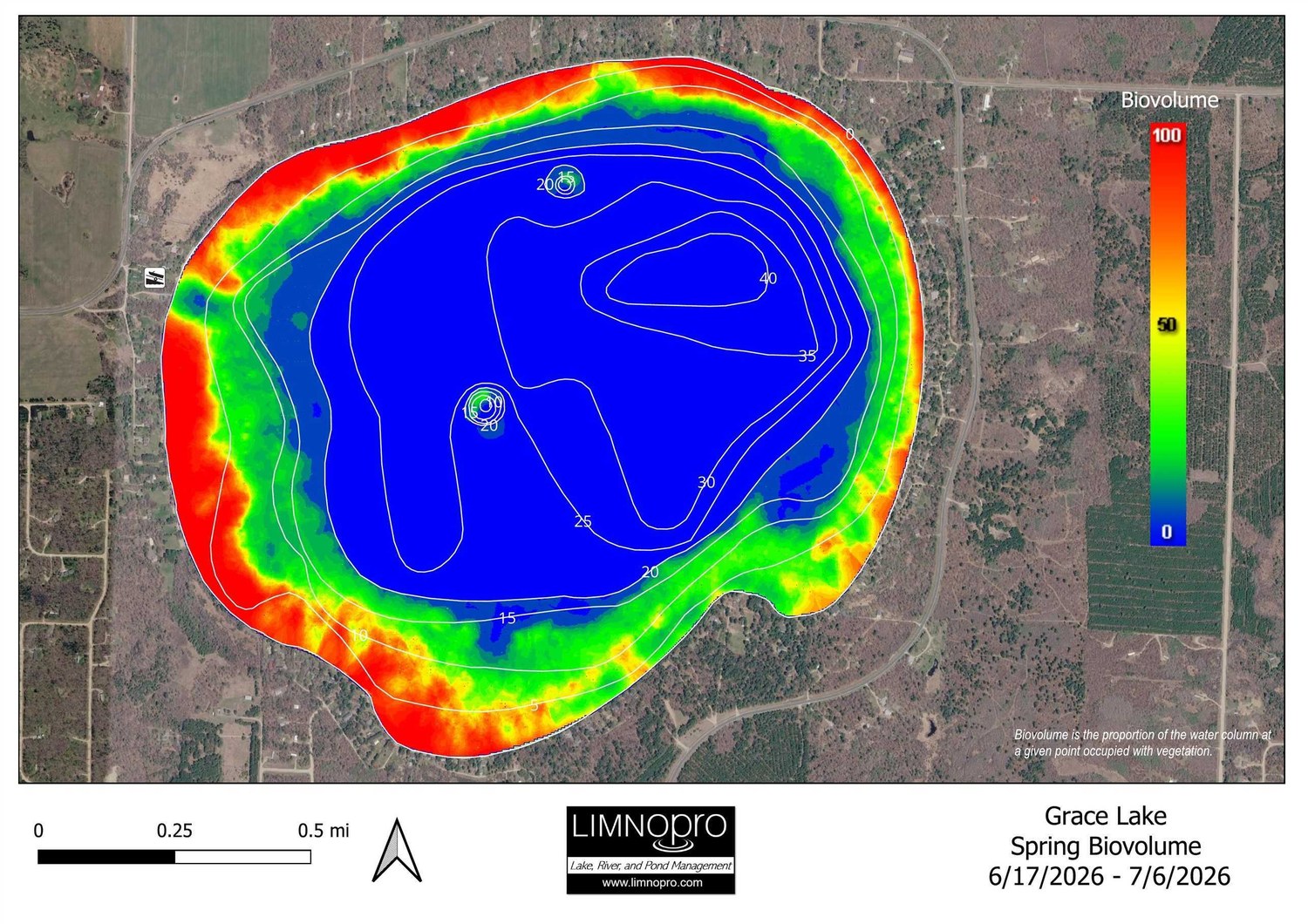
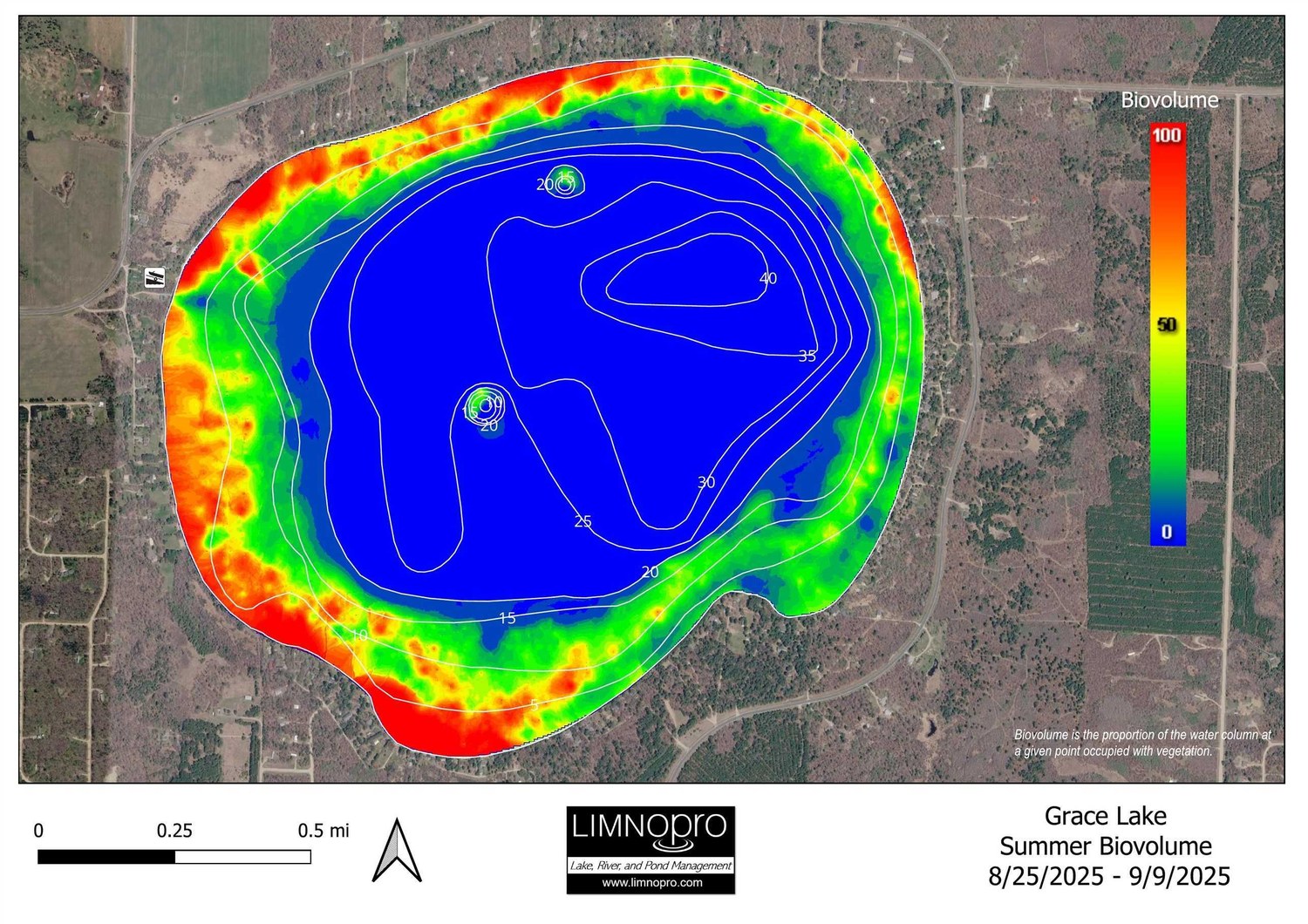
Between spring and late summer the vegetated area barely moves, but the plants get thicker inside it. Mean biovolume rose from 40.3 percent to 45.7 percent, and the area with at least half the water column filled grew from about 117 acres to 141 acres. In other words, the late-summer weed problem residents notice is existing beds filling in, not plants spreading into new water.

About the weeds on the west and northwest shores

Roughly 129 to 138 acres — about 15 percent of the lake — had plants growing within two feet of the surface during the surveys. That is where boating, swimming, and shoreline access get difficult, and it lines up with the shallow western shoreline where complaints are most common.

Those plants are native: flexuous naiad, Canadian waterweed, and flat-stemmed pondweed. The Association cannot legally treat native vegetation lakewide, and the survey found no ecological case for doing so. Individual property owners do have options under Minnesota DNR rules, summarized below.

Low water makes it worse. The report notes the lake reached its lowest recorded level on July 27, 2026, about 39 inches below the 2019 high — which means more of the lake bottom sits in the sunlit depths where plants thrive.

What a property owner may do along their own shoreline

Action DNR permit?
Cut or pull submerged plants
Up to 2,500 sq ft; up to 50 ft along shore or half your frontage; a 15-ft boat channel is also allowed.
No
Cut or pull submerged plants beyond those limitsYes
Remove emergent plants (cattails, bulrushes, wild rice)Yes
Remove floating-leaf plants beyond a 15-ft channel (water lilies, watershield)Yes
Use herbicides, algaecides, or an automated control deviceYes
Excavation, hydraulic jets, bottom barriers, prohibited-area removalNot allowed

Summarized from the report’s Table 5, based on current Minnesota DNR Aquatic Plant Management rules. Rules, fees, and allowable products change — check current DNR guidance before any work begins. If the plant you are targeting is curly-leaf, a different permit pathway applies; ask the DNR.
03 / Curly-leafEstablished, but still localized.

The spring survey picked up curly-leaf pondweed at 3 of 341 points — under one percent of the lake, and about two tenths of one percent of all plant material collected. The dedicated July 7 delineation then mapped five beds totaling 20.8 acres, plus four isolated plants or small patches. Together those beds cover roughly 6.1 percent of the lake’s 340-acre littoral zone.

The spot where the DNR pulled the original 2025 specimen was revisited during the delineation, and no growing curly-leaf was found there. No Eurasian watermilfoil and no starry stonewort were detected anywhere in the 2026 survey work.

The report states plainly that the Association’s plan to monitor the beds in 2027 rather than treat them is reasonable, given the limited footprint and the strong native community, and that treatment can be reconsidered if the beds spread or thicken. The full background on that decision, including identification photos and what to watch for, is on the Curly-leaf Response page.

04 / Water qualityClear water worth protecting.

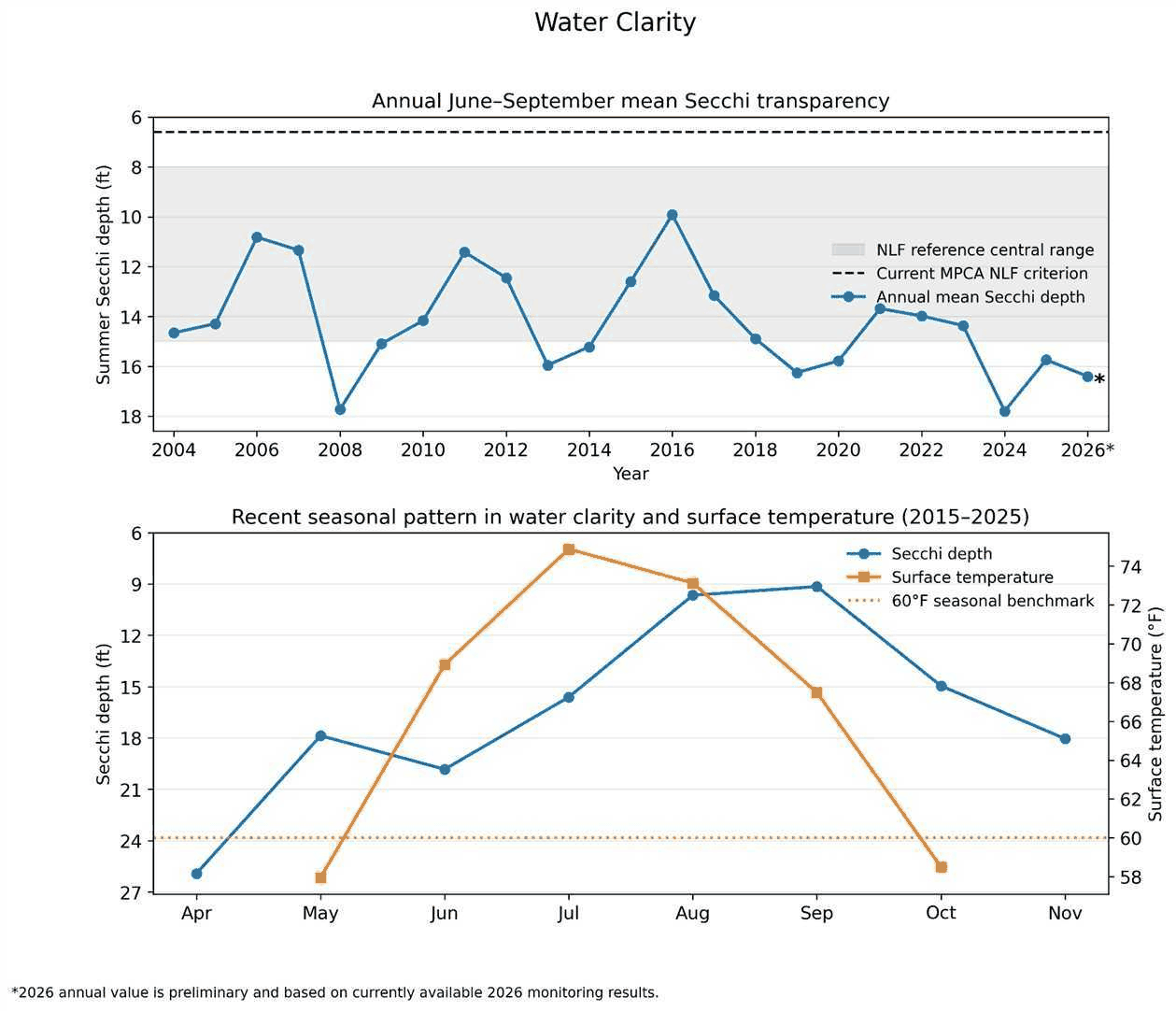
The report pulls together MPCA monitoring from 2004 through 2025. Across years with complete June-through-September coverage, Grace Lake averaged 14.1 feet of Secchi clarity, 27.3 µg/L total phosphorus, and 11.3 µg/L chlorophyll-a. That puts clarity near the clear end of the regional range, with phosphorus and algae just above it.

Measure Long-term 2025 Regional range MN standard
Total phosphorus (µg/L)27.324.314–2730
Chlorophyll-a (µg/L)11.38.54–109
Secchi clarity (ft)14.115.78–15≥ 6.6

Regional range is the central band among minimally disturbed Northern Lakes and Forests reference lakes. Higher Secchi numbers mean clearer water; higher phosphorus and chlorophyll numbers mean more algae.

Clarity swings hard through the season. Between 2015 and 2025 it averaged about 19.3 feet in June, falling to 9.8 feet in August and 8.8 feet in September as algae build up. That is why a single summer reading says very little on its own.

Why phosphorus matters more here than on most lakes

In its 2017 Mississippi River Headwaters assessment, the MPCA placed Grace Lake in its highest Lake Phosphorus Sensitivity Significance priority group. Chlorophyll-a was already above the standard, phosphorus was close to it, and clarity met it — mixed enough that the lake could not be classified either way.

The practical meaning: Grace is close enough to the line that a modest increase in phosphorus could noticeably cut water clarity — and because clarity is what lets plants grow deep, that would reshape the plant community too. Protecting what the lake has now is far cheaper than restoring it later. Maintaining shoreline vegetation, limiting runoff and erosion, keeping septic systems sound, and skipping phosphorus fertilizer all count.

05 / Next stepsWhat LimnoPro recommends.

  1. Monitor the mapped curly-leaf beds each spring. Revisit the five beds during peak growth in late May or early June and record boundaries, density, and whether they are getting in anyone’s way. This does not require another full survey.
  2. Search for other invasives each late summer or fall. A targeted shoreline search — and SCUBA at the public access where feasible — for Eurasian watermilfoil and starry stonewort. Their best detection window differs from curly-leaf’s.
  3. Repeat the full lakewide survey about every three years. Often enough to catch meaningful change, not so often that it eats the budget. Same grid, same scoring, so the comparisons stay valid.
  4. Protect the native plant community. No broad-scale vegetation removal. Keep any control localized, permitted, and aimed at genuine nuisance growth.
  5. Keep sampling water June through September. Monthly Secchi, phosphorus, and chlorophyll-a. Late August and September matter most, and consistent records are the only way to tell whether curly-leaf dieback ever starts moving the numbers.
  6. Keep up early-detection outreach. Residents reporting unusual plants and checking docks, lifts, trailers, and shoreline equipment. Catching something early costs a fraction of managing an established infestation.

Cite as: Limnopro Aquatic Science, Inc. 2026. Grace Lake Aquatic Plant Survey 2025–2026. Prepared for the Grace Lake Watershed Improvement Association. Prepared by Daniel C. McEwen, Ph.D.; field surveys by Ethan Hosey and Brayden Kraemer. Report content is the joint property of the Association and Limnopro Aquatic Science, Inc.