CLP Delineation Results In
20–25 acres mapped · See update
A first for Grace Lake
Curly-leaf pondweed has been found in our lake.
A single specimen recovered by the MN DNR in July 2025 was the first aquatic invasive plant ever confirmed in Grace Lake. Two surveys later, we now know the scope: roughly 20 to 25 acres across five beds. What comes next depends on us.
Latest update · July 2026
The delineation survey is complete — here is what LimnoPro found
LimnoPro finished mapping curly-leaf pondweed on July 7, 2026, following a point-intercept survey that ran from June 19 through July 6. They identified five distinct beds totaling 20.8 acres, plus four smaller isolated detections that add roughly two more — about 22.8 acres in all, or 6.7% of the lake's 340-acre littoral zone.
Two findings stand out. First, no growing plants were found at the original spot where the DNR pulled the 2025 specimen. Second, LimnoPro confirmed no Eurasian watermilfoil and no starry stonewort — as far as we know, curly-leaf and banded mystery snails are the only invasive species in the lake.
The final point-intercept report is still to come. On LimnoPro’s recommendation, the board decided on July 29, 2026 to forego chemical treatment for the 2027 season and to monitor the mapped beds instead — checking each spring whether they are holding steady or becoming a nuisance. That is the plan for 2027, not a permanent position; it will be reviewed as the monitoring data comes in.
What the MN DNR found, when they found it, and how we confirmed it.
On a routine fisheries sampling day in July 2025, biologists from the Minnesota Department of Natural Resources were working the southeast bay of Grace Lake when they pulled a gill net that contained something unexpected: a small, wavy-leafed plant fragment tangled in the mesh.
The specimen was photographed and sent to the MN DNR's Ecological Water and Resources Invasive Species group, which confirmed the identification as curly-leaf pondweed (Potamogeton crispus) and logged the record on the national EDDMapS invasive species database at coordinates 47.4049568, -94.735212, in about 10 feet of water.
Approximately one month later, between August 20–25, 2025, Limnopro Aquatic Science completed a full point-intercept survey of Grace Lake on behalf of the Grace Lake Watershed Improvement Association. Because that survey happened in late summer, it was too late in the season to find CLP — the plant dies back in early July. The Limnopro team did, however, uncover the EDDMapS record while researching the lake's history. That is how this all came to the board's attention.
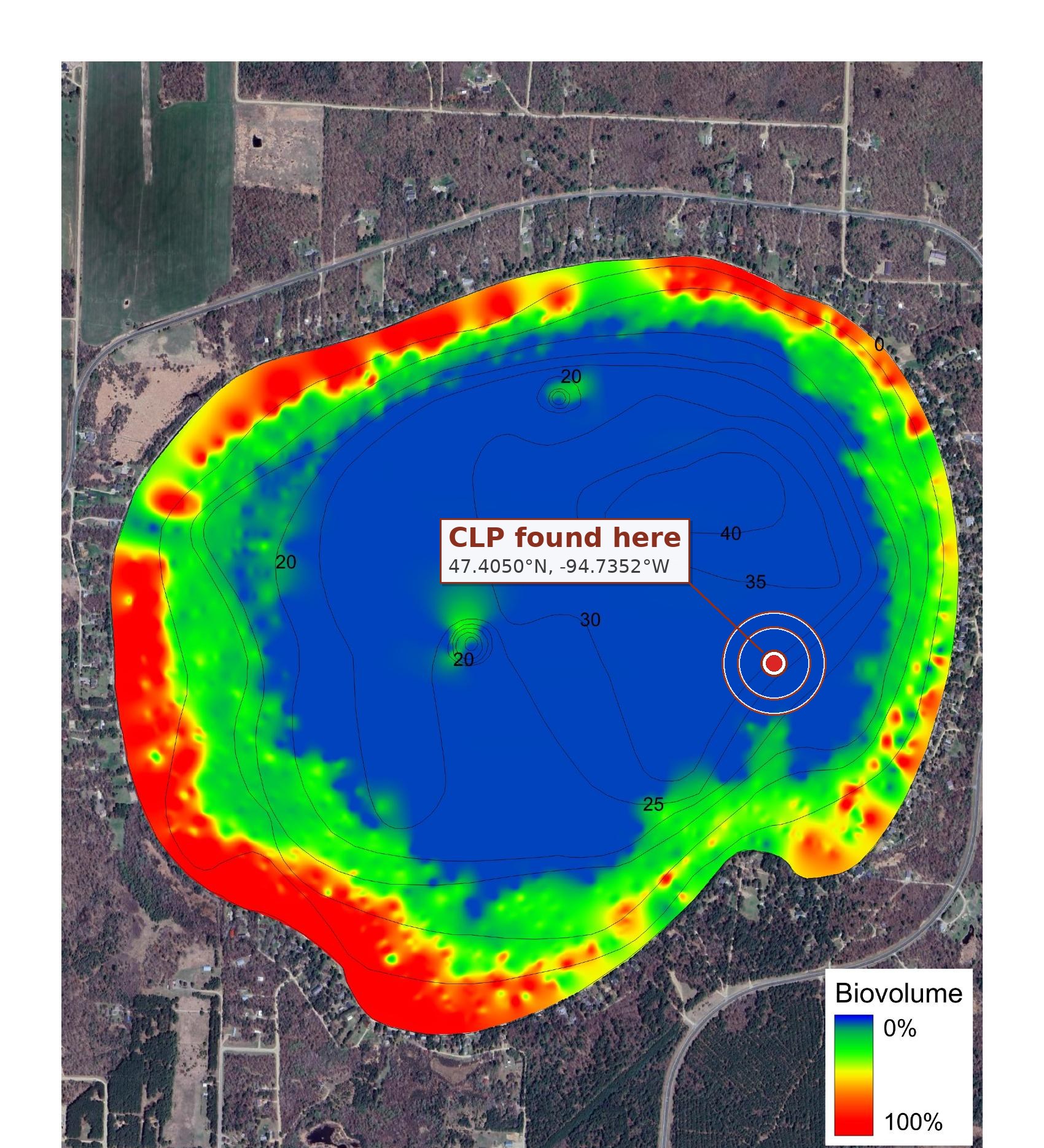
The colored band around Grace Lake is the littoral zone — where water is shallow enough for plants to grow. Red areas show the densest plant cover (the “weedline”); the deep blue center is too deep for rooted plants. The CLP specimen was recovered in the southeast bay, well within the plant-growth zone. Source: Limnopro 2025 Aquatic Plant Survey, biovolume percent map (Appendix A).
02 / The DelineationNow we know how much, and where.
Two surveys in the summer of 2026 answered the question the 2025 discovery raised: is this one stray plant, or an established population?
The 2025 discovery told us curly-leaf was present. It could not tell us how much. Answering that took two pieces of work, both timed deliberately to the plant's spring peak rather than the late-summer window that missed it the first time.
First came a point-intercept survey, run from June 19 through July 6, 2026 — a systematic grid of sampling points across the littoral zone, roughly one per acre, designed to detect where curly-leaf was growing. That work took about five days on the water, spread across a few weeks of starts and stops.
Then, on July 7, 2026, surveyor Ethan Hosey ran a meandering delineation survey — an 8.3-mile boat path following published MN DNR protocols, concentrating on the areas where the point-intercept work had turned up plants. Where the point-intercept survey answers is it here?, the delineation survey answers how big is the bed and where are its edges?
What the delineation found
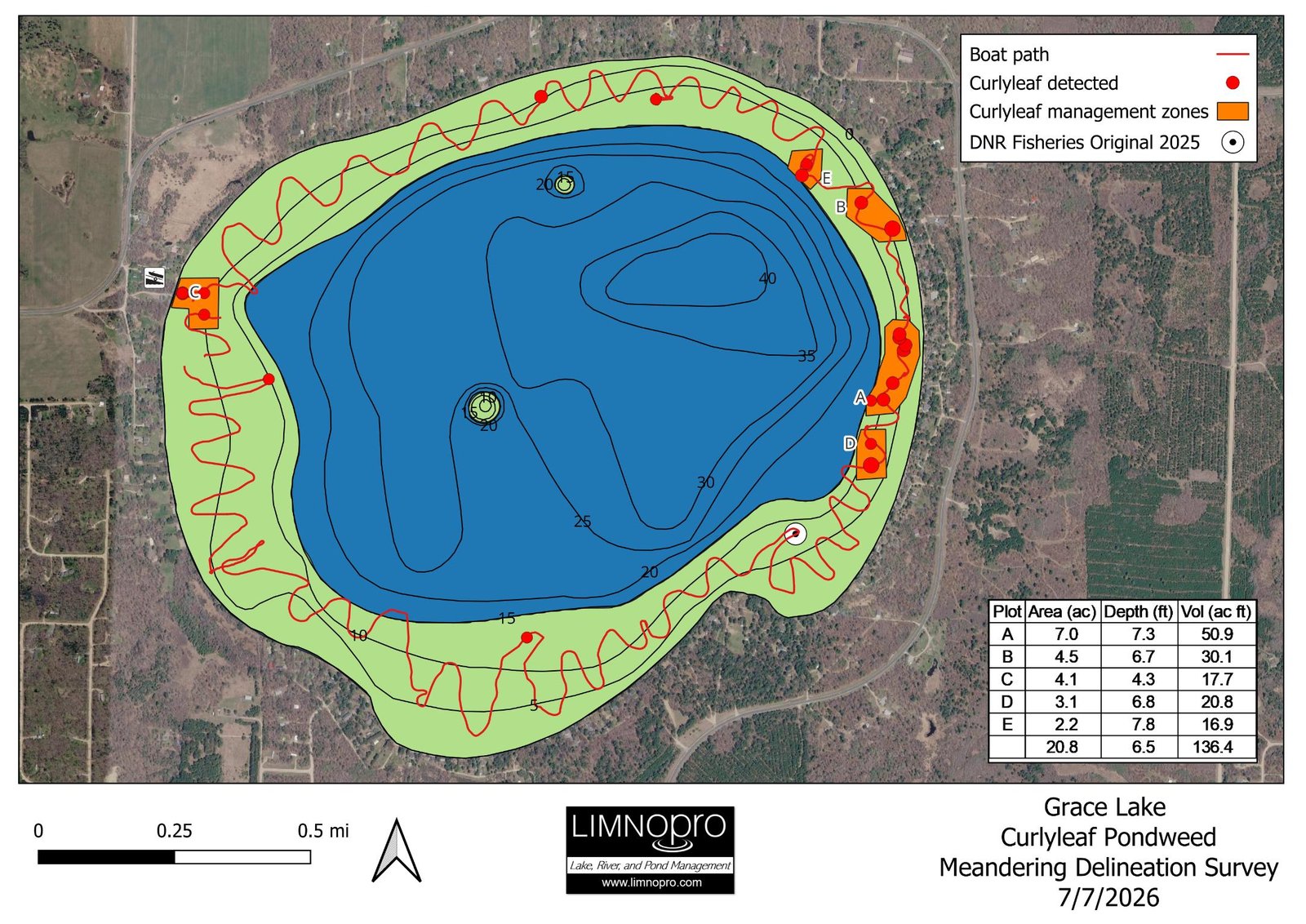
Five distinct curly-leaf beds totaling 20.8 acres — individually 7.0, 4.5, 4.1, 3.0, and 2.2 acres. Four additional isolated detections were too sparse to map as beds, but at a conservative half-acre each they add roughly two more acres.
Total coverage: approximately 22.8 acres, or about 6.7% of the lake's 340-acre littoral zone. Depending on how the boundaries are drawn, LimnoPro describes the result as 20 to 25 acres.
The July 7, 2026 delineation map. The red line is the 8.3-mile survey path; red dots are curly-leaf detections; the orange polygons are the five mapped beds, labeled A through E. The table gives each bed's area, average depth, and volume. Note that the beds cluster along the northern and western shorelines — not at the 2025 discovery point in the southeast bay. Source: LimnoPro Aquatic Science, Curlyleaf Pondweed Delineation Report, July 7, 2026.
Two findings worth pausing on
The original DNR point came up empty. LimnoPro deliberately meandered the exact location where the 2025 fisheries crew netted the specimen — and found no growing plants there at all. The plant that started this whole effort appears to have been a fragment that drifted from somewhere else, which is a useful reminder that a single find tells you very little about where a population actually lives.
Nothing else invasive turned up. LimnoPro reported no Eurasian watermilfoil and no starry stonewort anywhere in the survey. As far as we know, the lake's only aquatic invasive species are curly-leaf pondweed and banded mystery snails. Given how many nearby lakes are dealing with more than that, this is a real credit to years of boat-landing inspections.
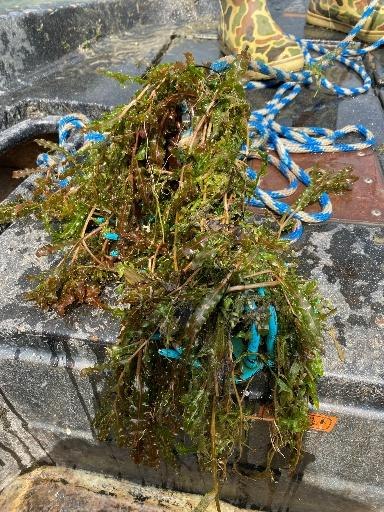
A sample rake pulled in Plot C, one of the denser beds. Source: LimnoPro delineation report, 2026.
How to read the acreage
Roughly 22.8 acres sounds like a lot, and in isolation it is more than anyone hoped to hear. In context, it is manageable. Minnesota's regulatory ceilings allow chemical herbicide treatment on up to 15% of a lake's littoral zone and mechanical harvesting on up to 50%. At 6.7%, Grace Lake sits well inside both limits — meaning the choice about what to do next is genuinely ours to make, not one constrained by the scale of the problem.
A non-native aquatic plant from Eurasia with an unusual life cycle that lets it get ahead of everything else.
Curly-leaf pondweed (CLP) is a submerged aquatic plant native to Europe, Asia, Africa, and Australia. It was first introduced to North America in the mid-1800s and has been working its way through Minnesota's waters for over a century. Within a 30-mile radius of Grace Lake, it has already been documented in at least 11 locations across Clearwater, Hubbard, Itasca, and Cass counties, with records dating from 1976 to 2025.
Field identification comes down to one unmistakable feature: the leaves.
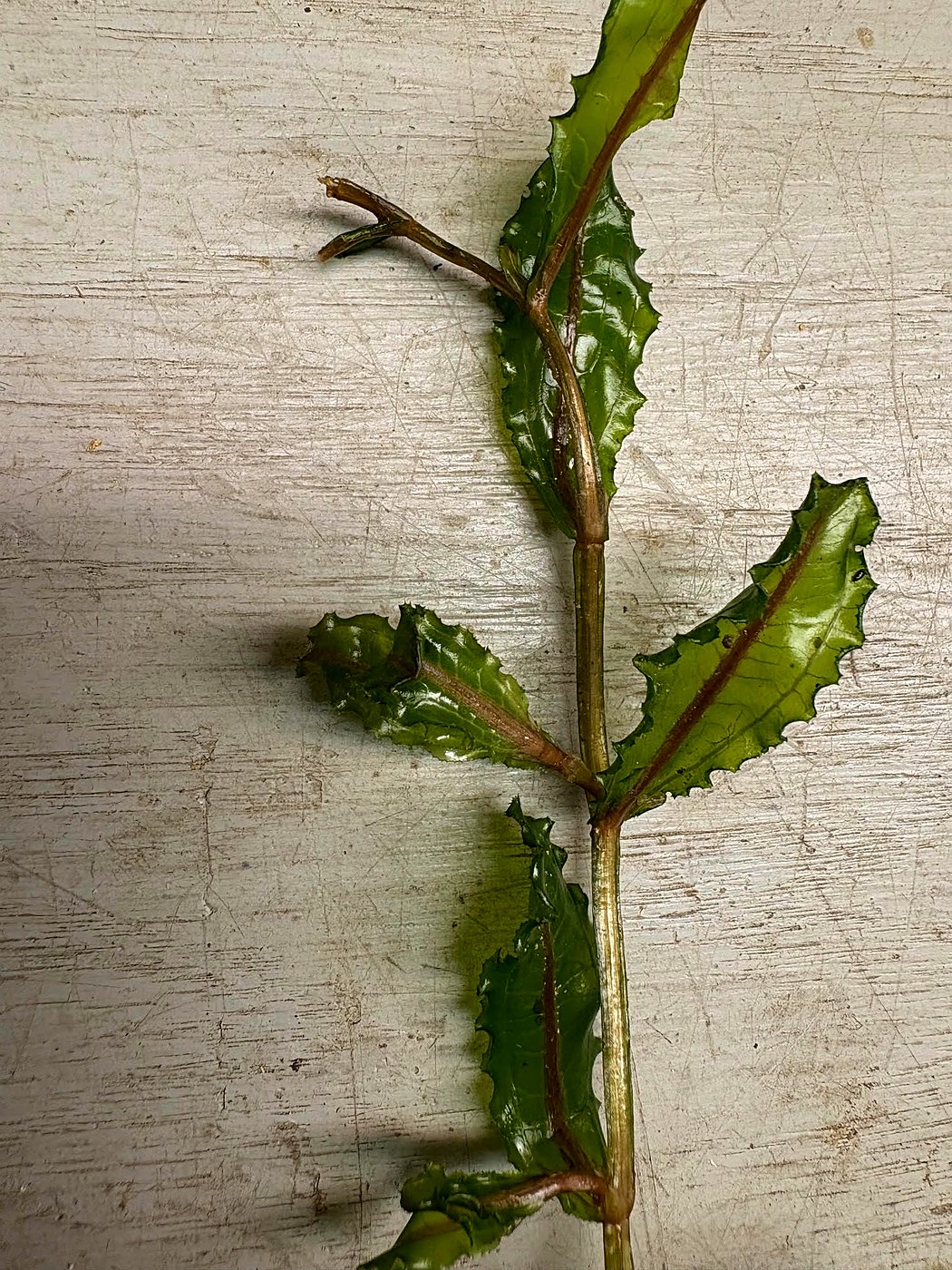
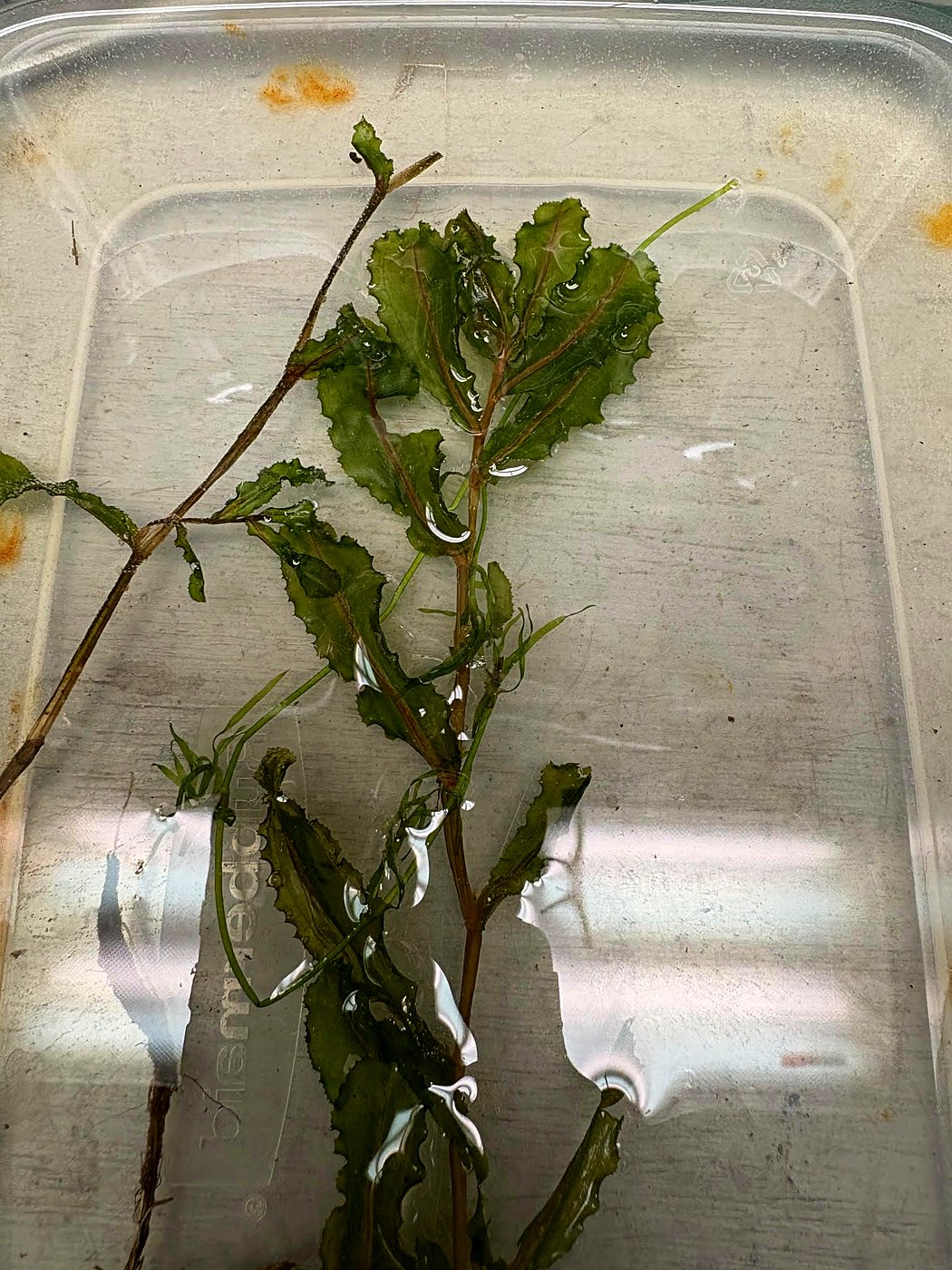
Alternating along the stem. Leaves attach one at a time on opposite sides of the stem — never in pairs. The stem is often reddish-brown.
The “lasagna noodle” edge. Leaves are oblong with rippled, wavy margins and fine teeth along the edge. Tips are rounded, not pointed.
Olive-green, turning bronze. Leaves are shiny olive-green in spring, often turning reddish-bronze before the plant dies back in early July.
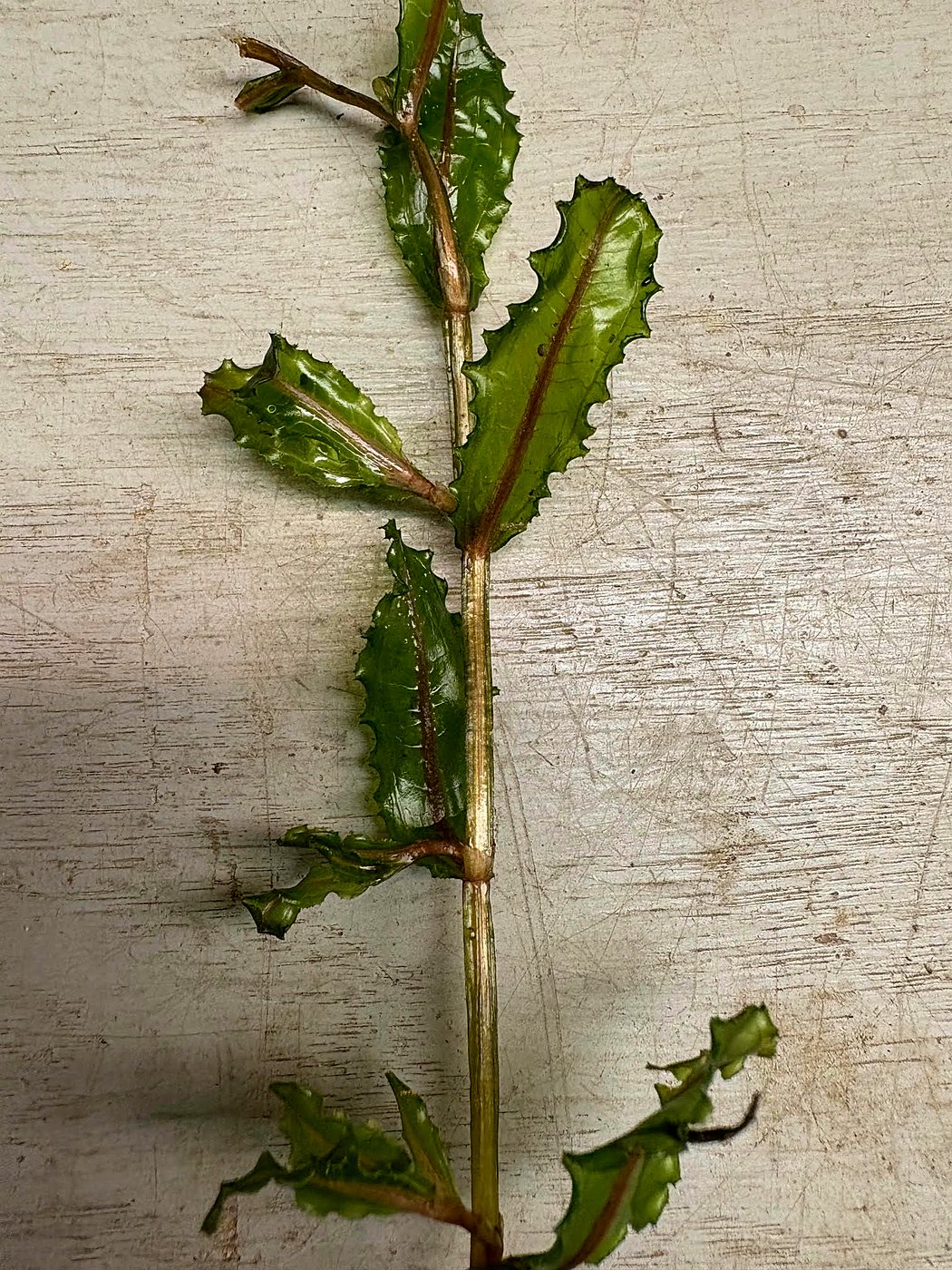
Actual photos of the curly-leaf pondweed specimen recovered from Grace Lake in July 2025. Young spring growth can look misleadingly like a native pondweed — take photos from multiple angles, showing both the whole plant and a close-up of the leaf edge.
Things to look for on the water
Wavy, rippled leaf margins — the edges undulate like a lasagna noodle or crinkle-cut potato chip.
Fine teeth along the leaf edge — visible up close, distinguishing it from smooth-edged native pondweeds.
Rounded leaf tips — not pointed; each leaf is 2–4 inches long.
Olive-green to reddish-brown color — especially when the plant is stressed or heading toward die-back in late June.
Leaves alternate along the stem — spaced, not whorled in circles.
Often the first plant up — if something is knee-high in April or early May before most other plants are going, look twice.
04 / The Life CycleWhy spring is everything.
Curly-leaf pondweed runs its whole calendar backwards. Understanding this is the single most important thing for spotting it.
Almost every aquatic plant in Minnesota waits for warm water. Native pondweeds, milfoils, coontail, and naiads start growing once the water reaches about 60°F, which in our part of the state means early June. They peak in July and August.
Curly-leaf pondweed does the opposite. Its seed-like "turions" sprout in the fall, the plants grow slowly under the ice all winter, and by April they're already several inches tall. By May and June they dominate. Then, just as natives are hitting their stride in early July, curly-leaf dies back — often dramatically — leaving behind a mat of decomposing plant material that can dump nutrients into the water and fuel late-summer algae blooms.
Curly-leaf pondweed reaches full size in May and June when natives are barely starting. By early July it has died back to the lake bottom — the main reason the Limnopro survey couldn't find it in late August. Your window to spot it is roughly late April through mid-June.
05 / The ImpactWhy lakes worry about it.
CLP doesn't always become a nuisance — but when it does, the effects are real.
On the water
Forms dense surface mats in spring that tangle propellers, foul fishing lines, and block swim areas.
Crowds out native plants that would otherwise occupy the same shallow habitat in spring.
In the water
Sudden July die-off releases nutrients — a trigger for algae blooms later in summer.
Decomposition can draw down dissolved oxygen in localized areas, stressing fish.
The severity depends heavily on how much CLP establishes and where. A few scattered plants in a bay do almost nothing measurable. A contiguous infestation across many acres changes a lake's character. That's why this matters now, while the Grace Lake find is still a single point on a map.
06 / The Good NewsGrace Lake is still in remarkable shape.
Before the alarm bells get too loud, a reality check from the 2025 survey: this is a healthy, diverse Northwoods lake with strong native vegetation and above-average water clarity.
23
native aquatic plant species found in 2025 (up from 20 in 2007)
91%
of sampled sites had native plant growth
340
acres of littoral (plant-growing) habitat on the lake
0
other invasive plants detected — no EWM, no starry stonewort, reconfirmed in 2026
What the 18-year comparison tells us
The 2025 Limnopro survey compared directly to the last full plant survey the MN DNR did on Grace Lake in 2007. Eighteen years apart, the plant community has held together remarkably well. Shallow coverage barely changed (96→91 percent), the dominant species kept their ranking (naiad is still king, as it was in 2007), and native diversity edged slightly upward. Several species — Canada waterweed, sago pondweed, northern watermilfoil — actually increased in frequency, which the report attributes to sustained water clarity extending the growing season.
Translation: the ecosystem is resilient. We now know curly-leaf occupies about 6.7% of the littoral zone — a real problem, but one arriving in a lake with a strong, diverse native plant community and good water clarity. That baseline is exactly what gives the Association room to make a considered decision rather than a rushed one.
07 / The PlanWhat the Association is doing next.
A grant, two surveys, and a decision point. Here is how the next 18 months are structured.
July 2025 · completed
CLP specimen recovered by MN DNR fisheries
Single fragment in the southeast bay. Verified by MN DNR Ecological Water and Resources Invasive Species group; logged to EDDMapS.
August 2025 · completed
Limnopro full point-intercept survey
340 sampling points across the littoral zone. Confirmed 23 native species and no invasive plants — though too late in the season for CLP detection.
May 30, 2026 · completed
Resident briefing & spring-watch update at 2026 Annual Meeting
The 2026 Annual Meeting was held at Bible Camp. Members received a CLP update, the MN DNR presented 2025 fish survey results (which confirmed the CLP fragment found in July 2025), and residents were asked to continue watching the shallows through early summer.
June 19 – July 6, 2026 · completed
Spring point-intercept survey
LimnoPro returned with the survey timed to CLP's peak growth rather than late summer. Roughly one sampling point per acre across the littoral zone, about five days on the water. This is the survey that located the plants. The final written report is still pending.
July 7, 2026 · completed
Meandering delineation survey — beds mapped
An 8.3-mile survey path mapped five CLP beds totaling 20.8 acres, plus four isolated detections — approximately 22.8 acres, or 6.7% of the littoral zone. No growing plants were found at the original 2025 DNR location. No Eurasian watermilfoil or starry stonewort anywhere in the lake. Full report (PDF).
July 29, 2026 · decided
Board sets the approach for 2027
At a special board meeting, Dr. Daniel McEwen of LimnoPro walked the board through the survey results and recommended against chemical treatment at this stage. The board voted unanimously to forego chemical treatment for the 2027 season and establish a board-managed monitoring plan for the mapped beds. Read the minutes.
Late summer 2026 · awaiting
Final point-intercept report & LimnoPro recommendations
LimnoPro has a draft complete and will deliver the final report shortly. It rounds out the picture of the lake’s native plant community alongside the curly-leaf beds already mapped.
Late May – early June 2027
Board-managed monitoring of the mapped beds
The board will revisit the five mapped beds during curly-leaf’s peak growth, when the plant is actually visible, to record whether they are stable, expanding, or reaching nuisance levels. LimnoPro advised that this does not require another full point-intercept survey — a meandering check of the known coordinates is enough to track year-over-year change.
2028 and beyond · if warranted
Revisiting the treatment question
If monitoring shows the beds expanding or genuinely interfering with recreation, chemical treatment goes back on the table. MN DNR permitting confines curly-leaf treatment to roughly April 30 – May 15, before later-emerging natives begin active growth, with planning needing to start by March 1 of that year.
Why the board is monitoring rather than treating
LimnoPro’s recommendation to the board on July 29, 2026 was to hold off on chemical treatment and watch the beds instead. The board agreed and voted unanimously to do that for the 2027 season. This is the responsible call for where the lake is right now — not a permanent position. If monitoring shows the beds expanding or getting in people’s way, treatment comes back up for discussion.
Once curly-leaf is established in a lake, as it now is here, no known method eradicates it. Permitted chemical treatments are contact herbicides: they knock back the visible plant but do not affect the underground structures or the reproductive turions that sprout the following fall, so annual regrowth should be expected. LimnoPro also does not recommend mechanical harvesting, which tends to fragment curly-leaf and spread it rather than control it.
Two things weigh against treating now. The first is disturbance: a herbicide application knocks back the native plants sharing that space as well, and those natives are part of what currently keeps the curly-leaf in check — clearing them can open ground for it to expand. The second is habitat. Grace Lake has low nutrient levels, soft water, and unusual clarity (20-foot Secchi readings this July), which makes it comparatively poor ground for the kind of surface-choking growth curly-leaf produces in the alkaline, nutrient-rich lakes of southern Minnesota. It may simply stay roughly where it is.
Their general guidance is that chemical treatment is worth considering only where growth reaches nuisance levels that genuinely interfere with recreation — not as a reflex. Were treatment to be pursued, they suggest diquat as a primary option and flumioxazin as a secondary alternative, at an estimated $300–$500 per acre. Any management action would be regulated by the MN DNR's Ecological and Water Resources Division through a structured permitting process.
About the funding
The Association's $5,000 grant covers the delineation survey, which came to $1,664.78. The point-intercept survey that found the plants in the first place — a necessary prerequisite to mapping them — is a further $4,689.11, and that cost falls to the Association directly.
The grant does also cover CLP management, and with treatment deferred that portion is unspent for now. It is worth knowing the scale problem for later: the grant was written on the expectation of treating somewhere in the range of 1 to 10 acres, and the surveys found roughly 20 to 25. At $300–$500 per acre it would not stretch across all of the mapped beds if the board ever needed it to.
Now that the beds are mapped, the most valuable things a resident can contribute are spring eyes on the water, careful boat hygiene, and support for the work ahead.
1. Watch the shallows again next spring
Curly-leaf has died back for this year — that is the die-off happening in mid-to-late July, and it is why the plant becomes nearly impossible to find in late summer. The next useful watch window runs from roughly mid-April through early July 2027. Take a few minutes when you're at the dock, or out boating, kayaking, or swimming, to scan the shallows. CLP prefers 2–10 feet of water, so you can often see it from the surface or with a mask. Look for any plant that seems ahead of everything else — knee-high when natives are barely up — with wavy, serrated leaves. New growth outside the five mapped beds is especially worth reporting.
2. If you see something suspicious, photograph it
Take several clear photos: one wide shot showing the plant in context, one close-up of a leaf showing the wavy margin, and — if you can reach it — a photo of the whole stem. Don't pull the plant up and move it; a tiny fragment can start a new colony elsewhere. If you want a specimen, cut a short stem and drop it in a sealed bag for same-day delivery.
3. Report it
Send photos with the approximate location (GPS coordinates or a dropped pin on a map app, plus the nearest landmark) using our contact form — choose the “AIS sighting / CLP report” topic. The Association will coordinate identification with our lake scientists and, if confirmed, log the find to the MN DNR's EDDMapS database. You can also log it yourself at eddmaps.org.
4. Clean, drain, dry — every time
Grace Lake is less than 30 miles from confirmed populations of CLP (11 locations), Eurasian watermilfoil (9 locations), starry stonewort (20 locations), and zebra mussels (71 locations). The same boats and trailers that bring your friends and family up for the weekend are the most likely vector for any of these. Before any boat leaves or enters Grace Lake: visibly inspect the hull, trailer, and live wells; drain everything; let it dry in the sun for at least five days before launching in another lake. This is the single biggest thing any one person can do to protect the lake.
5. Help fund the response
This summer's work cost more than the grant covers. The delineation survey ($1,664.78) is grant-funded, but the point-intercept survey that located the plants — a necessary first step before anything could be mapped — is $4,689.11 paid by the Association. The grant does cover management as well, though it was scoped for roughly 1 to 10 acres, not the 20 to 25 that turned up. The more immediate need is the boat-landing inspection program, whose costs have risen and which needs funding again next summer. Those inspections are a large part of why Grace Lake still has no zebra mussels, starry stonewort, or Eurasian milfoil, and we very much want to keep them going.
If you are able to give an additional $250–$500 this year, it makes a real difference. Every dollar goes directly toward protecting the lake. Donate through the Association →
09 / ResourcesGo deeper.
The full scientific report, the detailed search-area map, and trusted outside sources.
The July 7, 2026 meandering delineation survey. Includes the bed map, per-plot acreage and depth table, methods, and LimnoPro's management recommendations. Surveyor: Ethan Hosey.
The complete scientific report prepared by Daniel C. McEwen, Ph.D., CLP. 8 pages plus appendices including biovolume maps, canopy depth, sediment, and a plant atlas.
We would rather answer a question than have you wonder.
Use the contact form and choose the DNR grant / CLP management project topic — those go straight to the Grant Project Manager. Meeting minutes and past updates are on the meetings page.
Report a Suspected CLP Sighting
Found something suspicious in the shallows?
1. Photograph it — both a wide shot and a close-up of the leaf edge.
2. Note the location — GPS pin if you can, otherwise nearest landmark or dock number.
Every contribution goes directly to lake protection.
The Association runs the boat-landing inspection program that has kept Grace Lake free of zebra mussels and other AIS for years. Your donations — suggested $250–$500 this year — keep inspections staffed and help cover the 2026 survey costs that fall outside the grant. Donate here.
Grant Administration & Disclosure
2026 Invasive Aquatic Plant Management Project
Curly-leaf pondweed response · Grace in Hubbard County 2026
This project is primarily funded by a state grant appropriation from the Minnesota Department of Natural Resources (DNR). Per state grant requirements, the following individuals are responsible for the leadership and management of this grant on behalf of the Grace Lake Watershed Improvement Association.
Citations: Limnopro Aquatic Science, Inc. 2025. Grace Lake Plant Survey. Prepared for Grace Lake Watershed Improvement Association. 8 pp with appendices. Limnopro Aquatic Science, Inc. 2026. Curlyleaf Pondweed Delineation Report — Grace Lake (DOW 29007100). Survey date July 7, 2026; surveyor Ethan Hosey. This resident briefing summarizes and extends the full Limnopro reports. All scientific findings are attributed to the original authors. Last updated July 2026.